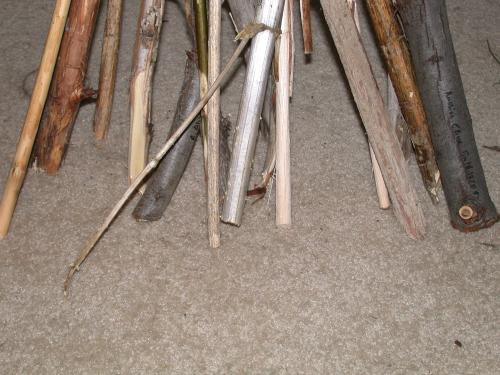
I've pretty much stopped counting how many friction fires I have achieved, but I haven't stopped practicing. The other day I tried out a new technique - I spun the hand drill while my roommate applied pressure with a handhold. We got a coal in no time. On the other hand I tried this morning at school (where we were basically outside so the temperature and humidity were less favorable than in the house where I'd done it before) and got some smoke but broke two spindles without getting a coal. So more work to be done before deciding how useful the technique is.
A while ago my brother asked me how it was that I was struggling with starting a fire by lighter but was being successful with friction fires. There are a couple of parts to the explanation. First is that I've mostly practiced friction fires inside with nice dry tinder bundles and kindling, while my attempts at lighter fires are outside - generally with damp everything. The second part is that in some ways it is easier to get a fire started from a coal than from a lighter because a good coal can dry out damp material around it and continue to supply heat until it flames up (though obviously the dryer the material the better.) With a lighter it can be difficult to apply even heat for long periods (I've had a couple lighters break on me because I kept the flame going for too long).
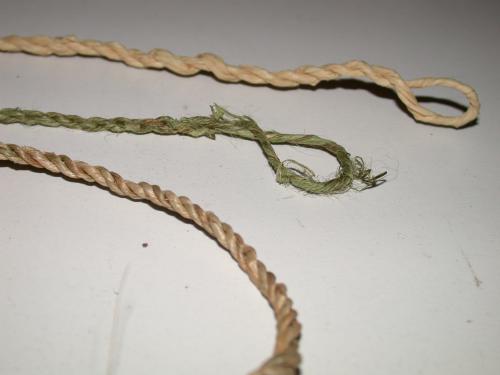
During the trip described in my last post Matt and I decided to try making a fire while out on our bike ride. He was skeptical that we could get a friction fire going, but I took that as a challenge and we scavanged a kit together. We even scavanged some twine to use as the bowdrill cord although it didn't take too long before we replaced it with some that he had brought with him (the twine had a strong fraying tendency). We tried the partner bowdrill method with big leaf maple on big leaf maple and later with doug-fir on big leaf maple (both of which I've had success with at home). We didn't manage to get a coal with the partner method, I think that the bow was a bit too long an unwieldy (I'd chosen a long one with the partner method in mind, but I guess should have stuck with a normal length bow). We tried for quite awhile, but eventually gave up as our arms got tired, our feet and hands continued to get colder, and our cord broke. We then tried for awhile to get a lighter fire started. We began by trying shavings from the big leaf maple. Matt was able to get single shavings burning, but never managed to get a critical mass going. While messing around with the big leaf maple sticks we had I noticed that I was able to pull off good strips of thin inner bark, much of which had remained dry (though only on some of the branches). That seemed like it would make good tinder, so I got as much of it as I could and split it up a bit into narrower strips. Matt was getting ready to start back because of the cold, but I wanted to make one good try with the inner bark, and sure enough it lit and started burning well. It did the second time anyway. The first time the flame was too close to my fingers so I dropped the bundle and it spread apart too much. The second time I held the bundle together with one of the longer shavings. We then used the shavings and some twigs to get the fire going and ended up staying there for another hour or so enjoying the fire and eating lunch.
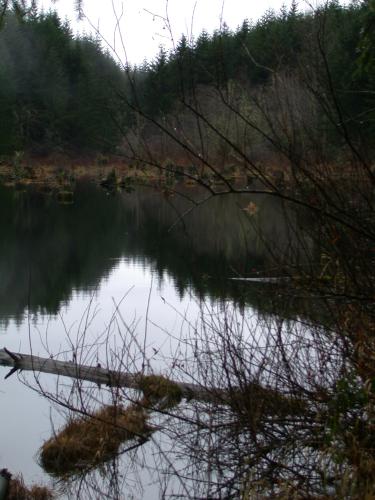 One of the first days of the term we broke up into our new clans and went on wanders. Trestle swamp, pictured here, ended up being our destination in the sense that we ate lunch there and more or less started heading back (by a different route) when we left it. It was my first time there and we saw what we think was an otter. We then built a fire, which was quite a challenge since we were in the middle of a long streak of consecutive rainy days in the area, but we finally managed with the proper application of pitch.
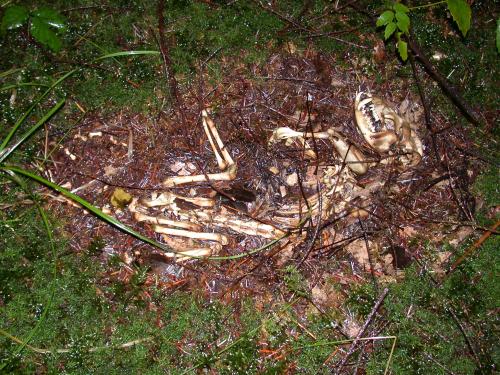 We found this amazing skeleton earlier in our wander. We were surprised by how little it had been disturbed. The best explanation we could think of was that it died of some disease which made it unappealing to other animals. Though we had some identification guesses, none of them seemed to fit the skeleton. It wasn't until we got back to look at some field guides that we decided it was a possum.