Thursday, December 15, 2005

Tracks and Cordage

A couple weeks ago we processed nettles that we had collected earlier in the term and used them to make cordage. It was surprisingly easy. To process the nettle we split the dried stalk and flattened it a bit, then snapped and pulled off small (an inch or three) sections of the inner wall from the fiberous outer material, working up the plant until all that's left are the fibers (being particularly careful around the joints of the stalk). Then we buffed the fibers a bit by rubbing it back and forth in our hands and carefully removed the chunky bits that tend to occur around the joints.

With the fibers processed we were ready to make cordage. The technique we used is called the reverse wrap. Taking two groups of strands you hold them from the end (or fold a group of strands in the middle and use the two halves), take the top bundle and twist it away from you than wrap it under the bottom bundle and repeat (now with the bundle that was originally on the bottom). The idea is that the twisted fibers are going against the direction of the wrapping so they won't unravel on their own very easily. You can also do reverse wrap with more than two bunches using the same process of taking the top one, twisting it and moving it to the bottom.

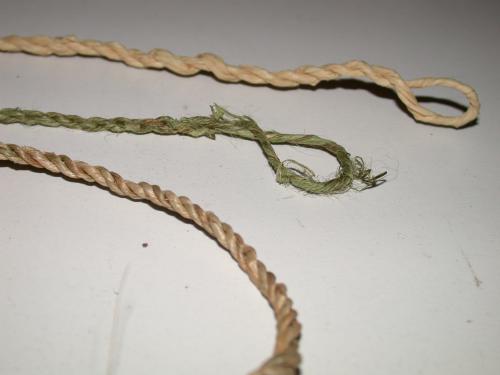
I made the top cord with some arts and crafts grass that the instructors gave us to practice with, the second cord is out of a stalk of nettle I processed and the third is a triple reverse wrap using strands of cattail. I was able to break the cattail cord with a fairly strong pull. Pulling as hard as I could, I was unable to break the grass or the nettle cord, though with two of us pulling pretty hard we managed to break the nettle (we didn't try that with the grass).

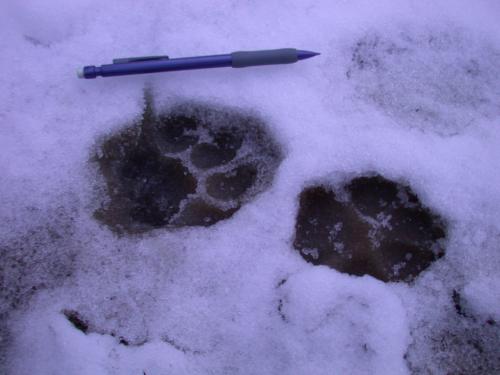
The top/left track is from the cougar that I was wrote about on the first. The bottom/right track is from the dog we were out with (a medium-large mutt). Though the picture isn't great for details, I can clearly see two of the major cougar vs. dog differentiators and can sort of see two others.

Tuesday, December 06, 2005

On Fire

I've pretty much stopped counting how many friction fires I have achieved, but I haven't stopped practicing. The other day I tried out a new technique - I spun the hand drill while my roommate applied pressure with a handhold. We got a coal in no time. On the other hand I tried this morning at school (where we were basically outside so the temperature and humidity were less favorable than in the house where I'd done it before) and got some smoke but broke two spindles without getting a coal. So more work to be done before deciding how useful the technique is.

A while ago my brother asked me how it was that I was struggling with starting a fire by lighter but was being successful with friction fires. There are a couple of parts to the explanation. First is that I've mostly practiced friction fires inside with nice dry tinder bundles and kindling, while my attempts at lighter fires are outside - generally with damp everything. The second part is that in some ways it is easier to get a fire started from a coal than from a lighter because a good coal can dry out damp material around it and continue to supply heat until it flames up (though obviously the dryer the material the better.) With a lighter it can be difficult to apply even heat for long periods (I've had a couple lighters break on me because I kept the flame going for too long).

During the trip described in my last post Matt and I decided to try making a fire while out on our bike ride. He was skeptical that we could get a friction fire going, but I took that as a challenge and we scavanged a kit together. We even scavanged some twine to use as the bowdrill cord although it didn't take too long before we replaced it with some that he had brought with him (the twine had a strong fraying tendency). We tried the partner bowdrill method with big leaf maple on big leaf maple and later with doug-fir on big leaf maple (both of which I've had success with at home). We didn't manage to get a coal with the partner method, I think that the bow was a bit too long an unwieldy (I'd chosen a long one with the partner method in mind, but I guess should have stuck with a normal length bow). We tried for quite awhile, but eventually gave up as our arms got tired, our feet and hands continued to get colder, and our cord broke. We then tried for awhile to get a lighter fire started. We began by trying shavings from the big leaf maple. Matt was able to get single shavings burning, but never managed to get a critical mass going. While messing around with the big leaf maple sticks we had I noticed that I was able to pull off good strips of thin inner bark, much of which had remained dry (though only on some of the branches). That seemed like it would make good tinder, so I got as much of it as I could and split it up a bit into narrower strips. Matt was getting ready to start back because of the cold, but I wanted to make one good try with the inner bark, and sure enough it lit and started burning well. It did the second time anyway. The first time the flame was too close to my fingers so I dropped the bundle and it spread apart too much. The second time I held the bundle together with one of the longer shavings. We then used the shavings and some twigs to get the fire going and ended up staying there for another hour or so enjoying the fire and eating lunch.

Thursday, December 01, 2005

Cougar Tracks

It's snowed a couple of nights in the past few days. On Wednesday morning I went biking with a friend from school. We were interested in checking some trails out that we'd hiked on previously and figured we'd cover more ground on bikes. Part of the way through we ran into a community schooler (Wilderness Awareness School's high school age program) and shortly after that we came upon some cougar tracks (from the previous night or the morning) with a bunch of community school tracks next to them. We trailed the tracks for a couple of miles along a logging road before running into a new group of kids and their leader. They had taken a break from trailing the cougar to try and build a fire in the wet woods. We talked to them for a bit and they told us that they had just heard on the handheld radio that one of the other groups had found something really cool, but it wasn't clear what. We continued on up the hill a short ways before seeing another bigger set of mountain lion tracks coming across the road. We looked up in the woods to see if we could trail that cat, but it was difficult in the duff. I did find a bird kill though, it was laying there - a bunch of feathers with a gut pile sitting on top. I'd never seen a kill site with a gut pile before, so that was interesting. I'm not sure what the bird was but I would guess it was around grouse size. After that we kept on up the road and didn't watch as closely for the cougar tracks and the next time we stopped to look for them they were gone. We thought that maybe the first one had left the road around the same place where the second one crossed. A couple miles later we stopped and built a fire (but that's another story), then headed back for home.

The friend lives with two of the community school intructors so after we got back home he called me to let me know what the cool thing was that they had found. Turns out some of the students had backtracked the cougar a short distance from where we picked up the trail and found a dead buck that the cougar had been eating on.

Sunday, November 13, 2005

Shelter Overnight


On Thursday we had a brief lecture on constructing shelters, we then went off into the woods and built some. This year, each clan chose to construct a "debris-pi" - sort of a tipi constructed with debris. We started construction probably around 11am and it gets dark around 5pm so we had time, but not an abundance of it. The basic format of the debris-pi was to build a sturdy frame out of sticks and then dump a bunch of debris on top, in this case mainly maple leaves that were in abundance and some sword fern that is also quite common there. Though it didn't rain much during the night, there was a moderate rain most of the day so it was challenging at times to keep energy up, but we soldiered on and by the time it was dark we were tired and wet but had a serviceable shelter. After the shelter had it's basic form complete we started a fire inside to start drying things out a little and to make sure that we had one before it got dark, we then continued to pile on more leaves and collect firewood to last us for the night.

The shelter was kind of tight with seven of us stuffed in, but there was enough room for us to all lay down as long as nobody minded having somebody else laying on top of them. Clayton had asked around the day before and got the good idea to store as much firewood as we could in the shelter and rafters with us. That worked out really well, helping to dry the wood and making it so we didn't have to keep going outside. It was also fortunate that everyone was interested in minimizing bathroom breaks, so we all tried to hold things in as long as possible and managed with only two mass excursions outside to take care of business. Other clans took bathroom breaks piecemeal and some used bottles so that they wouldn't have to go outside.

It took a little while to get a good blaze in the fire pit. With the wood so damp we needed it pretty hot to burn cleanly - smoke was something we constantly had to guard against. The fire kept everyone reasonably warm, although the person by the door was a little cold due to drafts, and if you had some part of yourself behind someone else (such as head or feet when trying to lay down) they would get chilled. The fire required constant vigilance since it would continually encroach upon the borders of the pit and would regularly catch some of the floor insulation (mainly sword fern fronds) on fire which we would then have to beat out.


It was difficult to sleep in the arrangement, some people didn't sleep at all a couple managed as much as two or three hours, I got probably between 15 and 30 minutes. We didn't really try to sleep for the first half of the night though, we realized how difficult it would be and instead stayed up singing songs and telling stories. I think that if we had stayed another night in the shelter it would have been easier to get more sleep. Probably some sleeping would be done during the day since the only urgent thing to do would be collection of firewood, and with the tiredness from the previous night we would probably be a lot more inclined to get down to the business of sleeping that night.

The bottom picture is of our clan in the morning, from left to right: Dave, Roy, Clayton, Emily (normally in a differnt clan, she joined ours for this activity), Me, Sean, Barbara
Wednesday, November 09, 2005

Sit Spot and Birds

Last week Jon Young came and spent a couple of days with our program. It was inspirational, but a lot to process all at once.

While he was there we went out to our bird sit spots for awhile and were supposed to come back with a question. I ended up having a lot of fun looking around my place and noticing a lot of things that I hadn't seen before.

In the past I haven't usually had much fun at my sit spot. Mostly I would try and concentrate more on what I was "supposed" to do, or start thinking about various internal distractions. After my experience above I decided to try and rekindle a sense of fun while at my spot. Instead of just going and doing what I was supposed to I went and paid attention to what caught my fancy. I explored around and watched birds, I ended up finding about five plants that I hadn't realized were in my area before (despite having previously cataloged all the ones that I was aware of). I still did what I had been focusing on in the past, but incorporated it into my fun.

One thing that Jon Young mentioned was the routine "owl entering the forest." Basically it entails taking a lot of care to avoid disturbing birds even before you start to leave your house for your sit spot. It takes a lot more time to get to my spot that way, so it's not something I'm likely to do everyday, but apparently the more you do it the less the birds will react to you even when you don't do it. I did it on Sunday and found it to be quite enjoyable. I noticed much more bird language than I had on probably any other day in my life. I think that's a mix of the exercise and my increasing awareness of birds in general. It makes me happy to realize how much more I recognize of birds now than I did at the beginning of the program. I still feel like I'm a beginner, but now I can distinguish several additional birds by their calls as well as being more aware of whether they are alarming.

Tomorrow we are going on to camp overnight in group shelters.

(BD: 17, HD: 7)